Facebook Ads Are Getting Expensive — Here\'s How Smart Nepali Businesses Are Pivoting to Organic Growth
The ad budget that stopped working Two years ago, a clothing retailer in Kathmandu's New Road area was spending about NPR 15,000 per month on Facebook ads and...
The ad budget that stopped working
Two years ago, a clothing retailer in Kathmandu's New Road area was spending about NPR 15,000 per month on Facebook ads and getting a reliable stream of enquiries — enough to keep the team busy and the register ringing. Then something quietly shifted. Last year, they doubled their budget to NPR 28,000 and got fewer enquiries than before. Same product, same city, same creative approach. They hadn't done anything wrong. The platform had simply gotten more expensive beneath their feet.
If you've been running Facebook ads in Nepal for more than two years, you've almost certainly felt this. The cost of reaching the same number of people has crept up, the clicks feel more expensive, and the results don't quite add up the way they used to. You're not imagining it. And you're definitely not alone.
This post explains exactly what's happening, why it's structural and not going to reverse, and — most importantly — what the smartest Nepali businesses are doing about it right now. Not instead of Facebook advertising, but alongside it, in ways that build something that lasts.
Why Facebook advertising has gotten harder — and why it won't get easier
Meta's advertising revenue crossed $130 billion globally in 2023. That staggering number tells you how many businesses around the world are competing for the same eyeballs in the same feed. When more advertisers bid for a finite amount of attention, the cost goes up — that's basic supply and demand, and it applies as much to a small business in Pokhara as to a multinational brand in New York.
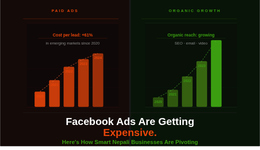
Meta's own data shows that average CPM — cost per thousand impressions — rose by over 61% between 2020 and 2023 across emerging markets in the Asia-Pacific region. Nepal sits squarely within that trend. The businesses that were running ads in 2020 for a few paisa per impression are now paying significantly more for the same reach, with no sign that the direction will reverse.
At the same time, something else is shifting: where Nepali audiences actually spend their time online. Facebook still has extraordinary reach — over 12 million users in Nepal as of 2024, making it the country's dominant social platform. But the share of attention going to other channels is growing. YouTube consumption has surged, particularly for longer-form content in Nepali. TikTok has captured younger demographics with extraordinary efficiency. And critically, more urban Nepali consumers are turning to Google search when they're ready to buy, not just browse.
Relying on Facebook ads as your only or primary customer acquisition channel is now a business risk. Not because the platform is dying — it isn't — but because over-dependence on any single paid channel leaves you exposed when that channel's costs move against you.
Paid ads rent your audience. Organic growth owns it. The smartest businesses are building both — but making sure they own something.
The numbers that should change how you think about your marketing
Before we get into what to do, let's anchor this in some data that reframes the conversation:
|
$36 : $1 : Average return on investment for email marketing (Litmus, 2023 Email Marketing Report) |
|
+180% : Organic traffic growth achieved by a Lalitpur training institute in 6 months after shifting to content marketing (2023) |
|
3× : Conversion rate of organic search visitors vs paid social visitors, in the same Lalitpur case study |
|
30% : Share of new customer enquiries a Birgunj hardware store now receives through YouTube organic video content — posted from a smartphone |
|
+61% Rise in CPM across emerging markets, 2020–2023 (Meta data) |
These aren't abstract global statistics — they're patterns playing out in businesses very similar to yours, right now, across Nepal and the wider South Asian market. The common thread in every success story is the same: a deliberate shift of some time and energy toward building organic channels that don't require ongoing payment to keep working.
Case study: a Lalitpur education centre stops buying audiences and starts earning them
In early 2023, a professional training institute in Lalitpur — offering accounting, IT certification, and business management courses — was spending NPR 22,000 per month on Facebook and Instagram ads. Enrolment was steady, but the cost per enrolled student had climbed by nearly 40% over two years, quietly eroding the margin on every course.
Their marketing team made a deliberate decision: instead of increasing the ad budget, they would commit to publishing two genuinely useful articles per month on the institute's website. Not promotional content. Not press releases about their achievements. Real, searchable, useful guides — the kind of thing their prospective students were actively typing into Google.
The first article was 'How to prepare for the Nepal government accounting exam in 2023.' The second was 'Which IT certifications have the best job placement rate in Kathmandu?' Both addressed questions the institute's admissions team answered verbally every single day. Now those answers were on the website, working around the clock.
Within six months, the website's organic search traffic had grown by 180%. More significantly, the leads arriving through search converted at nearly three times the rate of paid social traffic — because search visitors arrived having already decided they wanted exactly what the institute offered. They weren't browsing; they were ready. Total Facebook ad spend stayed flat, but total enrolments grew by 40% over the year.
The cost of those articles? About four hours of staff time per month, and a junior writer's fees of roughly NPR 4,000 per piece. The return has continued to compound month after month, with every article they publish adding to the institute's growing organic footprint.
The three organic channels worth investing in right now
- Search engine optimisation — the asset that keeps working
Every well-optimised page on your website is an asset. Unlike a Facebook ad, which stops the moment you stop paying, a good piece of content or a well-structured product page can send you enquiries for months or years without additional investment. For most Nepali businesses, the gap between their current Google presence and what it could be is enormous — and the distance between those two points is shorter than most people expect.
The fundamentals haven't changed: a verified and completed Google Business Profile, location-specific keywords in your page titles and descriptions, a fast-loading mobile-friendly website, and genuine local citations from Nepal-specific directories like Nepal Yellow Pages and Sajilo Sewa. These aren't exotic techniques. They're the basics that most Nepali businesses haven't done yet, which means the competitive landscape is still surprisingly open.
There is also a newer dimension worth understanding: Generative Engine Optimisation, or GEO. AI-powered search tools — Google's Search Generative Experience, Perplexity, and tools like it — are increasingly answering search queries directly, pulling their answers from well-structured, authoritative web pages. The businesses whose content appears in those AI-generated answers will have a significant advantage as this shift accelerates. The same practices that improve traditional SEO — clear structure, factual depth, local relevance — are exactly what gets you cited in AI answers.
- Email marketing — your warmest possible audience
Email has a perception problem. It feels old. It feels like spam. And yet the data is emphatic: the average return on email marketing investment is $36 for every $1 spent, according to Litmus's 2023 annual report. No other marketing channel comes close to that ratio.
The reason is simple. Your email list is composed entirely of people who chose to hear from you. That's your warmest possible audience — warmer than any ad targeting can achieve, because targeting approximates interest, while an email subscriber has demonstrated it. A monthly newsletter — business updates, a useful tip, a special offer for existing clients — keeps you top of mind with the people most likely to buy from you again or refer you to someone else.
In Nepal's relationship-driven business culture, this matters even more than in Western markets. People do business with people they remember and trust. Email is how you maintain that presence without requiring either party to remember to check in.
Getting started costs nothing. Export your existing customer list. Set up a free account on Mailchimp or Brevo. Write your first newsletter in the same conversational tone you'd use talking to a good client. Send it. Then do it again next month.
- YouTube and short-form video — organic reach that compounds
Nepal's YouTube penetration has grown dramatically over the past three years, driven by mobile internet expansion and the platform's strength with Nepali-language content. Businesses that recognised this early and started posting genuinely useful video content have built audiences that now send them a steady stream of new customers — entirely for free.
The hardware store in Birgunj we mentioned in the data section above started posting three-minute 'how to fix common plumbing problems' videos in 2022. Shot on a smartphone. No production team. No script beyond a rough outline. Within 18 months, those videos were generating roughly 30% of the store's new customer enquiries, because people who watched the videos trusted the people in them before they ever walked through the door.
Video works especially well for service businesses — accountants who explain tax filing, IT firms that walk through a cybersecurity checklist, architects who show a project from brief to completion. The video demonstrates expertise in a way that text cannot, and it builds familiarity and trust in a way that an ad can never replicate.
Short-form video for platforms like Facebook Reels and TikTok follows the same logic, with the added benefit that these platforms still actively boost organic short-form content to new audiences — making it genuinely possible to reach people who don't already follow you, without spending a rupee.
This isn't an argument against Facebook ads
To be absolutely clear: Facebook advertising still works. For product launches, seasonal promotions, re-engaging lapsed customers, or reaching genuinely new audiences at speed, paid social remains a powerful tool. Nothing in this post argues that you should stop running ads.
The argument is against over-reliance. A business that depends entirely on Facebook ads for its customer acquisition has put all its eggs in one basket — a basket whose cost is rising and whose walls are controlled by a company in California. A business with a strong organic foundation can use Facebook ads as an amplifier rather than a lifeline, turning a great piece of content into a great piece of promoted content, or using paid targeting to accelerate the growth of an email list that will keep delivering value long after the campaign ends.
That's a fundamentally more resilient position. And it's the one the smartest businesses in Nepal are moving toward right now.
The businesses that started building organic channels six months ago are already in a better position than those who didn't. The best time to start was six months ago. The second-best time is this week.
Where to start this week — a practical action plan
You don't need to overhaul your entire marketing strategy this month. Start with four specific actions:
- Audit your current Facebook ad spend: calculate your actual cost per lead over the last 12 months and compare it to 24 months ago. If it's risen significantly, you now have the business case for diversification.
- Identify three questions your customers ask you every week — those are your first three content pieces. Write them, publish them on your website, and share them on social. You don't need a content agency. You need to answer what people are already asking.
- Set up your email list today. Export your customer contacts, open a free Mailchimp or Brevo account, and commit to one newsletter per month. Keep it short, keep it useful, keep it human.
- Record one short video this week. Answer one question your customers ask. Post it on YouTube, Facebook Reels, and WhatsApp Status. Watch what happens.
- Spend 30 minutes completing your Google Business Profile — add photos, update your hours, respond to any existing reviews. This single action can meaningfully improve your local search visibility within weeks.
None of this replaces Facebook ads overnight. But six months from now, the businesses that started building organic channels today will be in a fundamentally different position — less dependent, more resilient, and growing in ways that don't require paying more every month just to stay still.
Ready to build your organic growth strategy?
At Orangic Smart Technology, we help Nepal-based businesses build digital marketing strategies that work long-term — combining smart SEO, content marketing, email, and social media into a coherent plan that reduces your dependence on paid advertising and builds equity in your brand.
Want a custom organic growth plan built around your business and budget? Get in touch with the Orangic Smart Technology digital marketing team — email us, use the website contact form, or message us on WhatsApp. No hard sell. Just a straight conversation about what will actually work for your business.
_1777367224.png)